Respiratory Protective Equipment (RPE) is common in many workplaces with the purpose of protecting an individual from inhaling hazardous particles, such as dust or airborne pathogens like COVID-19. However, every person has a different face and the degree of protection can vary depending on the fit of a particular make and model of respirator. IOH can help ensure the right protector is in use to keep your team members safe.
IOH Respirator Fit Testing (RespFit) uses the advanced TSI PortaCount™ device for a consistent and objective testing experience providing quantitative fit test (QNFT). The testing process includes movements and speaking scenarios to ensure fit is maintained during common work activity.
Fit testing can be conducted on many N95 masks including Half-mask, full-face, Disposable filtering-facepiece fit testing for Series 100/99/95/P1/P2/P3 masks, SCBA (Supplied Air Respirators) gas masks, CABA (Compressed Air Breathing Apparatus) masks and even PAPR (Powered Air Purifying Respirators).
Coal Worker’s Pneumoconiosis (Black Lung Disease), Asbestosis and Silicosis are common conditions a fit test is focused on protecting against. IOH’s team have also been called upon by our health network to provide fit testing for hospital staff to protect our frontline workers from transmittable respiratory infections like Covid-19.
Respirator Fit Testing can be provided in our Wollongong Clinic or onsite.
A functional assessment is used to provide feedback on the risk of injury of a worker in performing a certain role and taking about an hour to complete.
We also offer more comprehensive Functional Capacity Evaluation (FCE) service for Workers Compensation Claims and Medico-legal, involving Assessment and comprehensive report.
The most common time a functional assessment is used is for pre-employment or pre-placement. These are therefore commonly know as pre-employment functional assessments (PEFAs).
The components of a functional assessment may be prescribed by a statutory body or company requirements, or developed by our expert physical assessors for the specific demands of the role.
Some areas and testing including:
Height, Weight, BMI, waist-to-hip ratio and Blood Pressure
Musculoskeletal, Range of Movement and Flexibility Tests
Postural Tolerances, including planking, kneeling and squatting.
Cardiovascular Fitness using Step Test.
Lifting and Reaching, including overhead
Carrying
Manual Handling Assessment
Push and Pull
Grip Strength
and other Job Specific Testing
Functional Assessment is beneficial for any role that has physical demands, but can also be helpful for risks associated for sedentary workers.Appropriate functional testing can ensure you hire the right candidates to minimise future risk of workplace injury, protecting workers and making your workplace safer, demonstrating your commitment to Work Health and Safety (WHS) and your legislated obligations to your workforce.
If you wish to pursue employment of a worker who is flagged as higher risk, the functional assessment can help direct investment in health and wellness, or workplace modifications to support that worker stay safe at work.
A Functional Assessment will commonly take an hour to complete, although some short form functional assessments are available. Participants must wear suitable active wear with enclosed footwear to complete testing.
Spirometry is probably the most well-known of the pulmonary function tests (PFT). This is the test where we ask you to “keep blowing, keep blowing!” There is another test that can provide a wealth of information on how the lungs are actually exchanging the gases that keep us alive known as the diffusion capacity of lung for carbon monoxide or DLCO.
DLCO assesses how efficiently oxygen moves from your lungs to your blood. It’s a type of pulmonary function test that helps healthcare providers understand lung function. During the test, you inhale a gas mixture containing a small amount of carbon monoxide, measuring how much transfers to your blood.
What should I expect during a lung diffusion (DLCO) test?
During a DLCO test, a technician will put a clip over your nose or a mask on your face. They’ll have you:
Put your mouth over a mouthpiece attached to a machine. The machine will deliver the gas mix. It will also measure and record your results throughout the test.
Take a few normal, steady breaths.
Inhale deeply and exhale completely.
Breathe in quickly through your mouth.
Hold your breath for 10 seconds or as long as you can.
Breathe out.
Your technician may wait a few minutes and repeat the test at least one more time.
What does low DLCO mean?
Low DLCO means your lungs aren’t getting oxygen from the air to your blood efficiently.
Common conditions include:
Anemia – you have lack of hemoglobin to pick up the CO, so uptake is reduced.
Emphysema & COPD – The surface area has decreased due to thin and collapsible alveoli, so CO uptake is reduced
Pulmonary Fibrosis – The alveolar membrane is scarred and thick, so CO update is reduced
What does high DLCO mean?
Some conditions include:
Obesity.
Asthma.
Bleeding in your lungs.
Cardiac shunt.
Heart failure.
However, can also be high if exercise is completed before the test.
Spirometry is a common test to assess how well your lungs are functioning, but is only effective if done following strict procedures. Our spirometry technicians have completed the principally recognised Australian Accredited Spirometry Training to ensure they are competent.
IOH Health Wollongong Clinic is approved by Coals Service to complete Order 45 medicals and by Queensland Government Resources Safety & Health Queensland (RSHQ) as meeting Australia’s strictest Standard for Spirometry as developed by the Thoracic Society of Australia and New Zealand (TSANZ).
Qld RSHQ Registration number P0005418
Our spirometry is conducted using the strict health and safety guidelines for PPE and filters to ensure the health of participants and our staff are at the forefront of our testing procedures.
Spirometry forms an integral part of our Coal Mine Worker Medicals and health surveillance, especially for silicosis, a pulmonary fibrosis lung disease caused by breathing in tiny bits of silica. For workers in construction and mining spirometry can be an important diagnosis tool.
IOH Health can provide vaccination services at our Wollongong and Nowra practices.
Influenza (Flu)
Hepatitis A and Hepatitis B
Tetanus
Onsite Flu Vaccinations in the Illawarra
Our Wollongong based nurses can be booked to complete onsite flu vaccination services, ensuring your workforce is optimally protected for flu season. Vaccines must be pre-ordered. Any staff absent on onsite vaccination days can be booked to attend our Wollongong or Nowra practices for their dose.
We offer oral and urine drug screening, collection for direct laboratory testing and breath alcohol screening.
Our collectors have received a statement of attainment in accordance with The Australian Quality Training Framework, ensuring our testing procedures comply with the Australian Standards and we partner with NATA accredited laboratories ensuring sample security through appropriate chain of custody.
Medical Review Officer (MRO)
A medical review officer (MRO) is a registered medical practitioner with both knowledge and understanding of drug and alcohol test results, allowing for their interpretation with consideration of substance use disorders and is accredited by the Australian Medical Review Officers Association (AMROA).
Prescription and over the counter drugs can cause non-negative results in screening, and need further laboratory testing and interpretation. Our medical staff will perform basic interpretation; however, an MRO review is best practice or may be required in some instances to accurately identify appropriate use of approved drugs.
The MRO will also be able to recommend follow-up recommendations as necessary, such as re-testing, retraining or coordination of a drug and alcohol intervention program.
Australian Standards
AS/NZS 4380 – Procedures for specimen collection and the detection and quantitation of drugs of abuse in urine
AS/NZS 4760 – Procedure for specimen collection and the detection and quantification of drugs in oral fluid
Managing noise and preventing hearing loss at work is part of the responsibilities of a business owner. Part of an effective management strategy involves the establishment of baseline hearing thresholds for your workers and monitoring their hearing periodically.
IOH conducts our services to Australian Standard AS/NZS 1269:4 including ensuring:
audiometrists are appropriately trained and experienced.
audiometers are properly maintained, tested and calibrated, and
the acoustical environment meets requirements for maximal permissible ambient noise level (MPANL) i
IOH offer Audiometric Screening at our clinics:
Wollongong
Parramatta
Campbelltown
Maitland
Onsite Testing
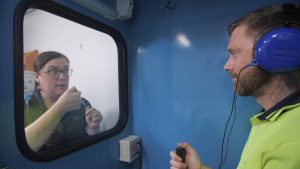
Onsite testing can be conducted in our mobile hearing booth or in a quiet room for smaller numbers.
Our onsite trailer is located in Wollongong from where we can cost effectively service southern NSW and Greater Sydney areas, and can accommodate other regions on request.