
About

Home » About

The Origins of IOH Health

IOH Health was founded on a simple belief: injured workers should not be left to recover alone, and employers should not be left without practical guidance.

In the early 1980s, Dr John Hogg saw that work injuries were often being managed through fragmented systems. Workers could be treated medically, but the connection back to the workplace was often missing. Too many injured workers were left to rehabilitate by themselves, with consequences for their recovery, their confidence, their families and their employers.

One story captured the problem clearly. A worker had injured his hand and was not yet fully recovered.Dr Hogg could see that a safe, supported return to work could help him recover more quickly and more completely. But when he looked for someone at the workplace who was interested in helping the worker return before he had fully recovered, there was no clear system, no obvious person to coordinate the process, and no practical pathway forward.

Surely, there had to be a better way.

Dr Hogg and his wife Linda believed the Illawarra needed a service that could bring medical care, workplace understanding and rehabilitation together. After 18 months of extensive research looking at industrial health systems in Australia and overseas, they opened IOH in 1984 from a purpose-renovated house in Foley Street, Gwynneville. It had a clear purpose: to reduce the human and financial cost of work injuries by helping people recover and return to participation safely.
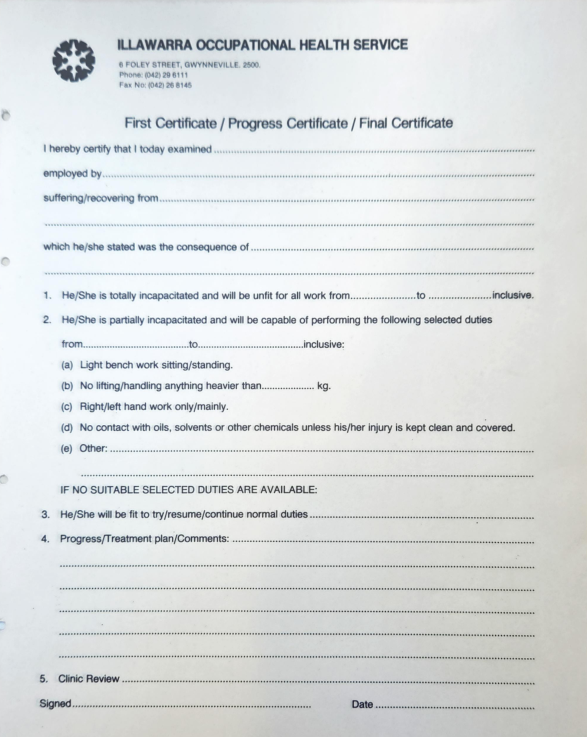
IOH’s Historic Recover at Work Certificate

The need for that service was immediate.

The focus was on the capacity to participate meaningfully in work and the Certificate of Capacity we use today evolved from Dr Hogg’s initial grasp of focusing on a graded recover-at-work plan.

IOH’s early work showed that coordinated, workplace-focused rehabilitation could help people recover more effectively while also supporting employers. For one of IOH’s first clients, the involvement led to a significant reduction in workers compensation insurance premiums in the first year alone. But more importantly, it showed that better outcomes were possible when injured people, health professionals and workplaces worked together.

Those beginnings shaped who we are today.

IOH grew through periods of major change in the Illawarra, including contraction across the steelworks, coal mines and other industries. By providing a responsive and practical service, IOH not only continued, but expanded its range of expertise. In 1987, when the State Government introduced WorkCover, IOH became one of the first rehabilitation providers accredited by NSW WorkCover, and was later approved by Commonwealth Comcare.

Quality has also been part of IOH’s story from early on. As expectations for formal quality systems developed, IOH recognised that it was not enough to be a quality-focused organisation; we also needed to be able to demonstrate that quality through external standards and accountability.

Today, IOH Health has grown from its occupational health origins into a multidisciplinary health provider supporting people across work, life and community settings. Our services have expanded, but our founding purpose remains recognisable: to provide practical, coordinated care that helps people move forward.

We continue to work with individuals, employers, insurers, NDIS participants, families and support networks to help people realise and achieve their potential for life, work and play.

Our history reminds us that recovery is not only about time away from work, treatment appointments or reports. It is about connection, capacity, confidence and the right support at the right time.

That is the origin of IOH Health — and it remains at the centre of what we do.

Our growth to support the NDIS

With the introduction of the National Disability Insurance Scheme, many people in our community were faced with a new and unfamiliar way of accessing disability supports. For participants, families and service providers, the NDIS brought opportunity, but also complexity — new language, new processes, and the need to clearly demonstrate what supports were reasonable and necessary.

IOH Health was approached by friends and family who needed help understanding and navigating this new insurance-based scheme. Our long experience working within insurance systems meant we understood the importance of clear assessment, evidence-based recommendations and well-reasoned reports that could support decision-making.

Having worked for many years with insurers, employers, doctors and injured workers, IOH had developed strong capability in preparing reports that explain a person’s functional needs, link those needs to practical supports, and justify why those supports are necessary. This experience translated naturally into the NDIS environment, where participants often need comprehensive documentation to support access to services, assistive technology, home modifications and capacity-building supports.

IOH Health understood where our existing strengths could be applied, but also knew we needed broaden our clinical capability for the disability sector. To meet this need, we began recruiting complementary therapists and team members with specific expertise in disability, therapy, assistive technology, home modifications and community-based support, and this facilitated the development of our unique disability support model. These new skills expanded our understanding and strengthened the services we could provide to participants and families.

Just as importantly, we built a team that includes people with lived experience of disability and caring roles. Their insight helps us stay grounded in the “why” of our services, and better understand the real-world challenges participants and families face, and has kept our approach practical, respectful and grounded in everyday life.

Today, our role remains person-centred and practical: to understand each person’s goals and circumstances, identify the supports that will help them participate more fully in life, and provide the evidence needed to support fair and appropriate funding decisions.

Who we are

The IOH team includes an extensive multi-disciplinary team of doctors, nurses, occupational therapists, physiotherapists, exercise physiologists, psychologists and rehabilitation counsellors, supported by experienced administrative teams.

Our mission is “to empower people to realise and achieve their potential for life, work and play”, and this directs how we seek to understand the needs and motivations of our clients, whether individuals or companies, to deliver solutions that meet their goals.

IOH Health now supports people across worker insurance, CTP insurance, the NDIS disability sector, aged care, Defence services and personal health services for members of the broader community.


Our goal is to ensure people can access professional, timely and appropriate care, regardless of how their support is funded. We recognise that each funding stream has its own requirements, expectations, reporting obligations and legislative requirements. Our team works to understand these nuances so we can provide services that are not only clinically sound, but also practical, responsive and aligned with the needs of participants, clients, referrers and funding bodies.

IOH continues to innovate and evolve in response to changing needs of our community.

Our Registrations, Accreditation and Governance

IOH Health operates in NSW Australia (ABN 12 346 324 078)

IOH Health is an Accredited Workplace Rehabilitation Provider

  • Comcare  (12251)
  • SIRA NSW
    • Wollongong (027)
    • Parramatta (304)
    • Penrith (916)
    • Ingleburn (899)
    • Southern Highlands (900)
    • South Coast (303)

IOH Health is a Registered NDIS Provider (4050002118). This means we can support NDIS participants regardless of whether their funding is NDIA-managed, plan-managed, or self-managed. This is important because it helps ensure participants can access IOH Health’s services regardless of how their NDIS funding is managed, and that their funding-management arrangement does not become a barrier to care. It also gives participants the flexibility and confidence to change their funding-management arrangements without interrupting their continuity of care with IOH Health.

Our registration also holds us accountable to the stricter quality, safeguarding, and auditing requirements of the NDIS Commission. This provides participants, families, and referrers with confidence that IOH Health’s systems, processes, and services are independently reviewed and certified to meet NDIS Practice Standards.

IOH Health Wollongong is accredited under ISO 9001:2015, the internationally recognised standard for quality management systems. The IOH Health Quality Management System is followed across IOH offices, supporting a consistent approach to service delivery, strong governance, and an ongoing commitment to continuous improvement.

Founded in 1984 by Dr John Hogg

Need Assistance?
We are here to help

Quick Enquiry